


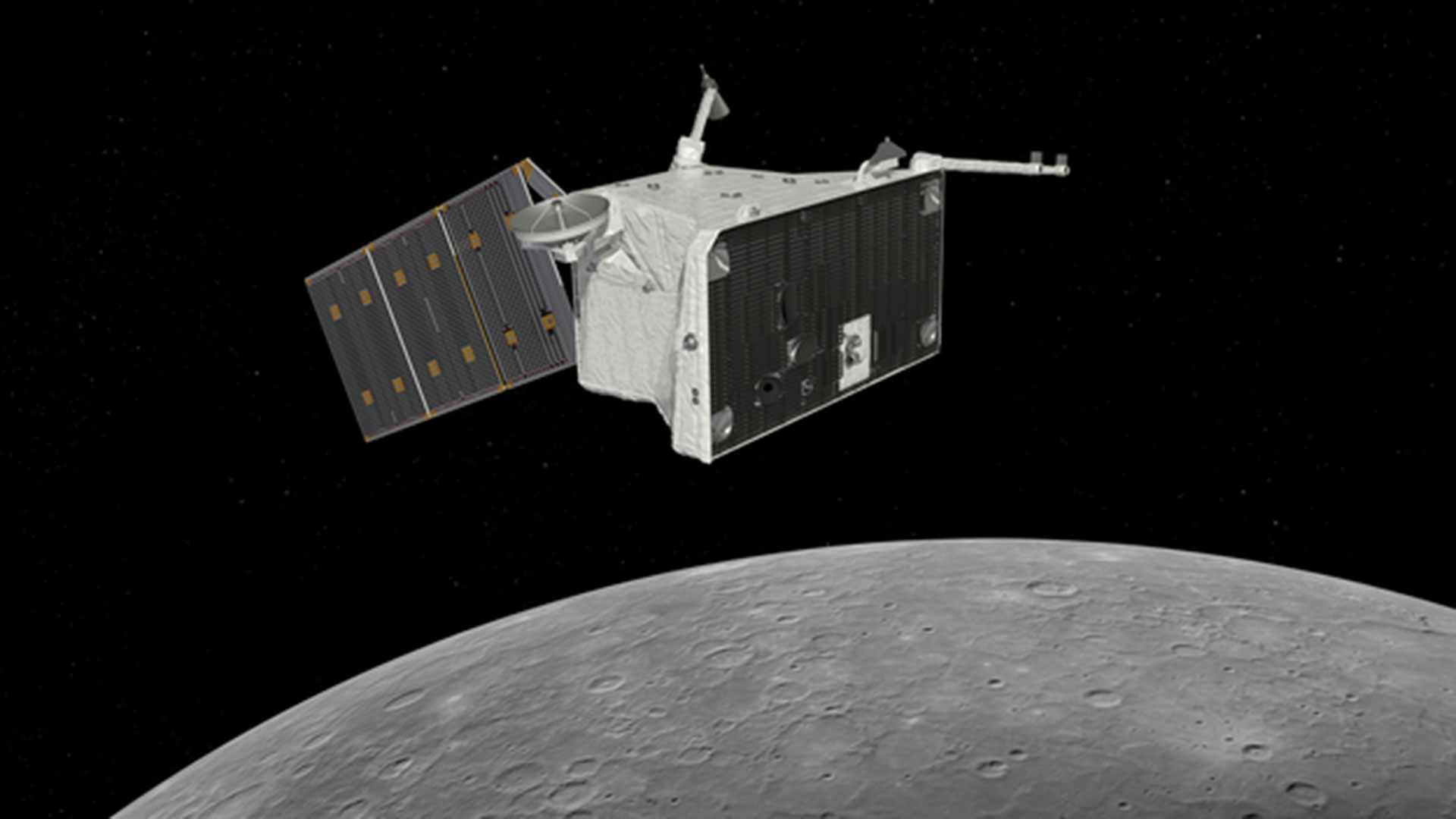
The IA2 staff joins in the enthusiasm for the first light of the Simbio-Sys project, processed on the servers of INAF's USCC-IA2 group.
As reported in thefull article with images published on the Media INAF website:
A major new milestone has been reached for BepiColombo, the joint mission between the European Space Agency (ESA) and the Japan Aerospace Exploration Agency (JAXA) dedicated to the study of Mercury. On September 15, Simbio-Sys (Spectrometers and Imagers for MPO BepiColombo Integrated Observatory System) turned on its three optical channels in their final configuration for the first time, demonstrating the proper functioning of the entire system and acquiring its first image. Simbio-Sys is one of the flagship scientific instruments of the mission and represents a significant achievement of international collaboration in which Italy plays a leading role, with strong support from the Italian Space Agency (ASI), scientific leadership from the National Institute for Astrophysics (INAF), and contributions from national industry.
The first light came after eight years of space travel and following the separation, on September 3,of the module that accompanied BepiColombo during its long cruise toward Mercury. The tests on September 15 were completed successfully, and the initial telemetry data confirms that the instrument is operating correctly. Over the coming weeks, fine-tuning of certain operational conditions will take place to prepare Simbio-Sys for the mission's scientific observations.
Simbio-Sys was designed to observe Mercury from different, complementary perspectives. Its three channels will work in synergy to build a comprehensive portrait of the planet, combining stereoscopic and high-resolution images with data on surface composition:
The first is Stereo Imaging Channel (STC): The channel dedicated to stereoscopic imaging. It will acquire images from two different angles while the spacecraft orbits Mercury. This will make it possible, for the first time, to create a global 3D map of the planet. The images will have a resolution down to about 60 meters per pixel, allowing scientists to identify craters, tectonic structures, volcanic formations, and other surface features.
The second is High Resolution Imaging Channel (HRIC): The high-resolution imaging channel, featuring a spatial resolution of about 6 meters per pixel, which will enable the observation of much smaller surface details than those identifiable in global mapping images. It will be particularly useful for studying impact craters, geological structures, volcanic features, and other processes that have shaped the planet's surface.
The third is Visible and Near-Infrared Hyperspectral Imager (VIHI): The channel dedicated to hyperspectral analysis, which will analyze light reflected from the surface in the visible and near-infrared spectra. Rather than just showing how the terrain looks, it will identify the materials and minerals composing it. This compositional information can then be correlated with surface morphology and geological history.
The combination of these three channels represents one of the most innovative aspects of Simbio-Sys: images, topographic information, and compositional data will be collected and interpreted together, offering a complete view of Mercury's surface.
"The first light of Simbio-Sys is a particularly meaningful moment for the entire instrument team: after nearly eight years of interplanetary cruise, the instrument has acquired its first images," says Raffaele Pepe, ASI program manager for the scientific and industrial activities of Simbio-Sys. "First and foremost, these images confirm the health of the instrument and have allowed us to verify the proper operation of the acquisition systems after such a long and complex journey. It is therefore a crucial step ahead of the mission's upcoming scientific activities—a significant result for the Italian scientific and industrial community, which contributed substantially to building Simbio-Sys and preparing it for this complex mission to Mercury."
"Although this was our first attempt to observe the sky with Simbio-Sys, we were able to capture several stars as point sources of light using STC," comments Gabriele Cremonese, INAF researcher and scientific principal investigator for Simbio-Sys. "We are extremely pleased with this result, as it confirms the instrument's potential to deliver excellent performance once we begin observing Mercury. We are thrilled that scientific observation of the planet can start with the nominal mission in April 2027. This first light confirms the excellence of the Italian scientific community and industry, together with the Italian Space Agency, in developing space instrumentation."
Behind Simbio-Sys lies an extensive international collaboration built over many years, bringing together scientific, technological, and industrial expertise. The core team comprises 118 scientists and engineers from twelve countries, supported by numerous researchers and early-career scientists involved in observation planning, instrument management, and data analysis.
Italy plays a primary role in this team: ASI supported the instrument's development alongside the French Space Agency (CNES), while INAF leads the scientific component. Added to this is the contribution of national industry, with Leonardo acting as the industrial partner for the integrated Simbio-Sys experiment. It is precisely this collaboration among research institutions, space agencies, and industry that made it possible to fly an instrument designed to answer fundamental questions about Mercury's history.
Mercury is the smallest rocky planet in the Solar System and the closest to the Sun. Besides Earth, it is also the only terrestrial planet with a global magnetic field. Despite its proximity, it remains a world that is still largely misunderstood. Observations from Simbio-Sys will help reconstruct the planet's history: from its volcanic and tectonic activity to the large impact events that scarred its surface, down to the nature of surface materials and the interactions between the terrain and the surrounding environment.
Launched in October 2018, BepiColombo is preparing to enter the final phase of its journey. Orbit insertion around Mercury will begin on November 21, 2026. The first light of Simbio-Sys thus marks a vital milestone toward the mission's scientific phase, when collected images and data will help tell the story of Mercury with an unprecedented level of detail.
Another major milestone will be the separation of ESA's Mercury Planetary Orbiter (MPO) and JAXA's Mercury Magnetospheric Orbiter (MIO), scheduled for December 9–10, 2026. Following this separation, BepiColombo will become the first mission to operate two spacecraft simultaneously in orbit around Mercury.